
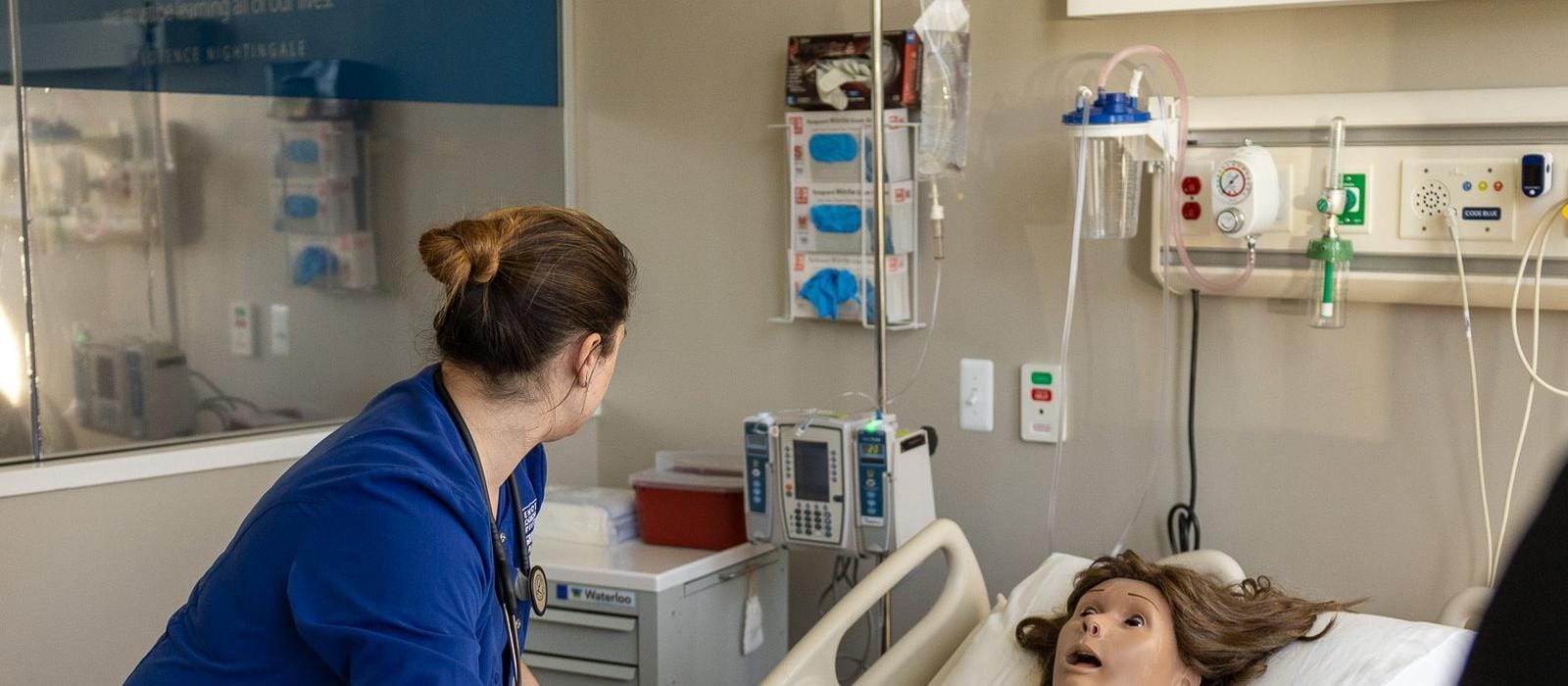
Course description
Care of adults with common acute and chronic conditions, with clinical rotations in medical–surgical units.
Adult Health Nursing I is an advanced undergraduate course in Nursing (NURS 3000), carrying 5 credits, and is typically offered fall, alternate years.
Prerequisites
NURS 2200, NURS 2400. Prerequisites are enforced at registration; a registration override from the department is required to enroll without them. This course in turn serves as a prerequisite or a recommended background for later courses in the sequence.
What you will be able to do
By the end of the course, a student who does the work should be able to:
- Explain the core concepts, terms, and methods of adult Health Nursing I.
- Analyze and solve open-ended problems in nursing, justifying the approach and the result.
- Carry out laboratory or field procedures safely and correctly, and interpret what the results mean.
- Communicate technical findings clearly in writing and in discussion, for a specified audience.
Each section publishes its own specific, measurable outcomes on the syllabus; these are representative.
How it is taught
Advanced coursework that combines focused instruction with substantial project, studio, or laboratory work. You are expected to work independently and in teams on problems that do not have a single clean answer, and to defend your choices. Scheduled hands-on time is a required part of the course and cannot be made up casually.
Workload and assessment
As a 5-credit course, expect roughly 10–15 hours of work outside scheduled class time each week, on top of lab or studio hours. Grades are typically based on a mix of laboratory, studio, or fieldwork, a term project or portfolio, quizzes or exams, and participation in critique or seminar discussion, in proportions each instructor sets. Late-work, attendance, and academic-integrity policies are on the section syllabus, which is the authority in any conflict with this page.
Where it fits
Adult Health Nursing I counts toward the Nursing program and is available as an elective to students in related majors; it may also apply to a minor or a general-education category. See the Nursing course list for the full sequence, and your degree audit for exactly how it applies to your requirements. If you are not sure whether to take it, your academic adviser can tell you where it lands in your plan.
Topics you can expect
Sections vary, but a typical offering of Adult Health Nursing I spends time on:
- The vocabulary of nursing and the questions the field is trying to answer.
- Core methods, and how practitioners actually apply them.
- Reading, evaluating, and citing evidence, sources, or specifications.
- A recurring problem type worked from a blank page to a defended answer.
- The notation, tools, or software that is standard in the area.
- How the individual pieces fit into a larger system or argument.
The section syllabus sets the actual schedule and the order these are covered in; this list is representative, not a contract.
Materials and cost
Plan on a course fee for consumable lab, studio, or field materials (listed with the section at registration), plus one text. The course fee is charged with tuition and covers materials the course consumes; personal protective equipment or a few small supplies may be your responsibility. Where a no-cost open option covers the learning outcomes, the department uses it, so wait for the section syllabus before buying anything. Any figure here is illustrative — UW–Porter Falls is fictional and sets no real prices.
Common questions
Can I enroll without the prerequisite? Not through self-registration. If you have equivalent preparation from transfer work or experience, ask the Nursing department for a registration override before the term begins.
Will it count toward my major or a general-education requirement? It always counts toward Nursing. Whether it satisfies a category in another major, a minor, or general education depends on that program's rules — check your degree audit or ask your adviser.
How heavy is the workload? Budget about 10–15 hours per week beyond scheduled class time, plus your lab or studio hours. Students who fall behind in the first three weeks tend to stay behind, so pace the early work.
Fictional information
UW–Porter Falls is a work of parody. Every course, prerequisite, credit value, and department on this page is invented; nothing here describes a real curriculum or a course you can enroll in.