
About
Porter Falls, Wesconsin
The mill town on the Porter River that the university has shared a Main Street with since 1893.
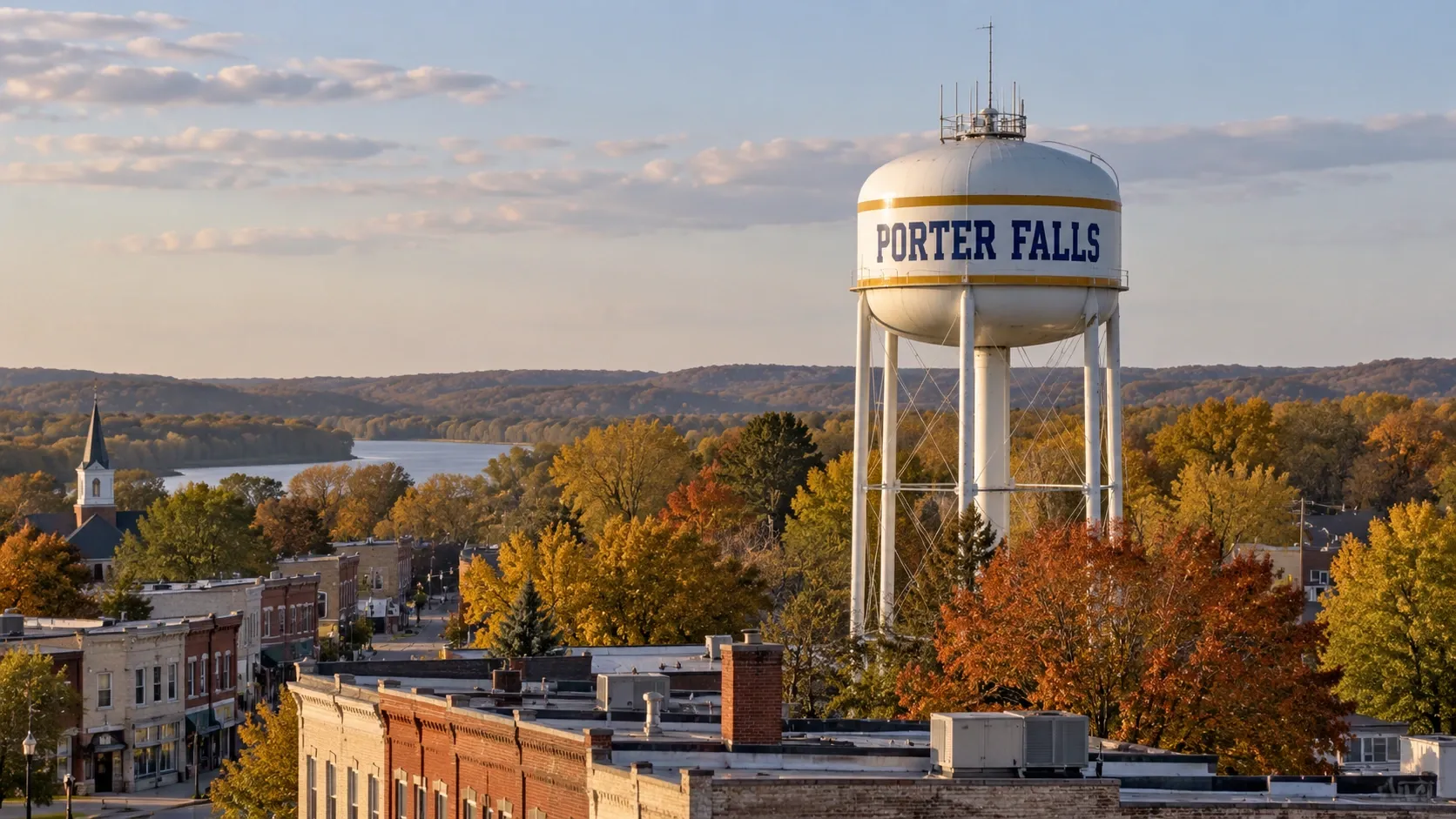
A river town before it was a college town
Porter Falls, Wesconsin (population about 17,000, seat of Porter County) grew up around a sawmill and a small ironworks built where the Porter River drops over a limestone shelf and splits into the Millrace, an artificial channel dug in the 1850s to run the mill wheels. The falls gave the town its name and its first industry; the manual training school the state chartered in 1893 gave it its second one, and the two have never really separated. Ask a longtime resident why the old athletic teams were the Millwrights and they will point at the river, not the campus.
Downtown and the Depot District
Main Street runs along the river through what locals call the Depot District, named for the 1911 rail depot at its north end — now the university’s Welcome Center, shared with the UW–Porter Falls Foundation. Within a few blocks of it are Foundry Coworking (home to the university’s small-business clinic on Thursdays), a handful of independent shops and diners, and the Saturday farmers market on the Depot Plaza from May through October. None of it is large. Most of it is walkable from campus in under fifteen minutes, and a fair amount of it depends on the university for its customers outside of tourist season.
Living off campus
Students who move off campus after their first year mostly end up in the blocks between Founders Union and downtown, an area with a mix of older houses converted to rentals and a few newer apartment buildings built in the last decade specifically for that market. The city and the university jointly publish a rental-housing guide each spring covering leases, inspections and tenant rights, because a fictional college town has real, fictional landlord disputes like anywhere else.
Getting around and getting out
The Porter Loop shuttle covers campus and the Depot District on a twelve-minute schedule during class hours; a separate regional coach connects Porter Falls to Lake City (about forty minutes east, the nearest hospital system hub and regional airport) and to the Cities (about seventy-five minutes west), with a stop at the Welcome Center. Most students do not keep a car on campus for the first two years; most eventually wish they had one for a co-op three towns over.
Weather, honestly
Winters are long and genuinely cold — January averages well below freezing, and the university publishes a weather-closures policy for a reason. The Riverfront Trail is plowed before the rest of the sidewalks in town, which students notice and appreciate more than the city council would probably like admitted publicly. Summers on the river are short, warm and, by regional consensus, worth the previous eight months.
Town and gown, specifically
Porter Falls Area School District and Cedar Bluff School District both partner with the university on precollege programs and student teaching placements. Valley Health’s Porter Falls clinic is the training site for much of the College of Health Sciences’ clinical rotations. The Porter County Economic Development Corporation and the university’s outreach office share a small-business intake form so a local owner only has to explain their problem once. None of this is unusual for a college town this size; it is, however, the reason so many campus pages on this site mention the same handful of local names.
See it for yourself.
Campus tours walk the Millrace path from the Depot into Founders Hall — downtown and campus, in one visit.