
Episode summary
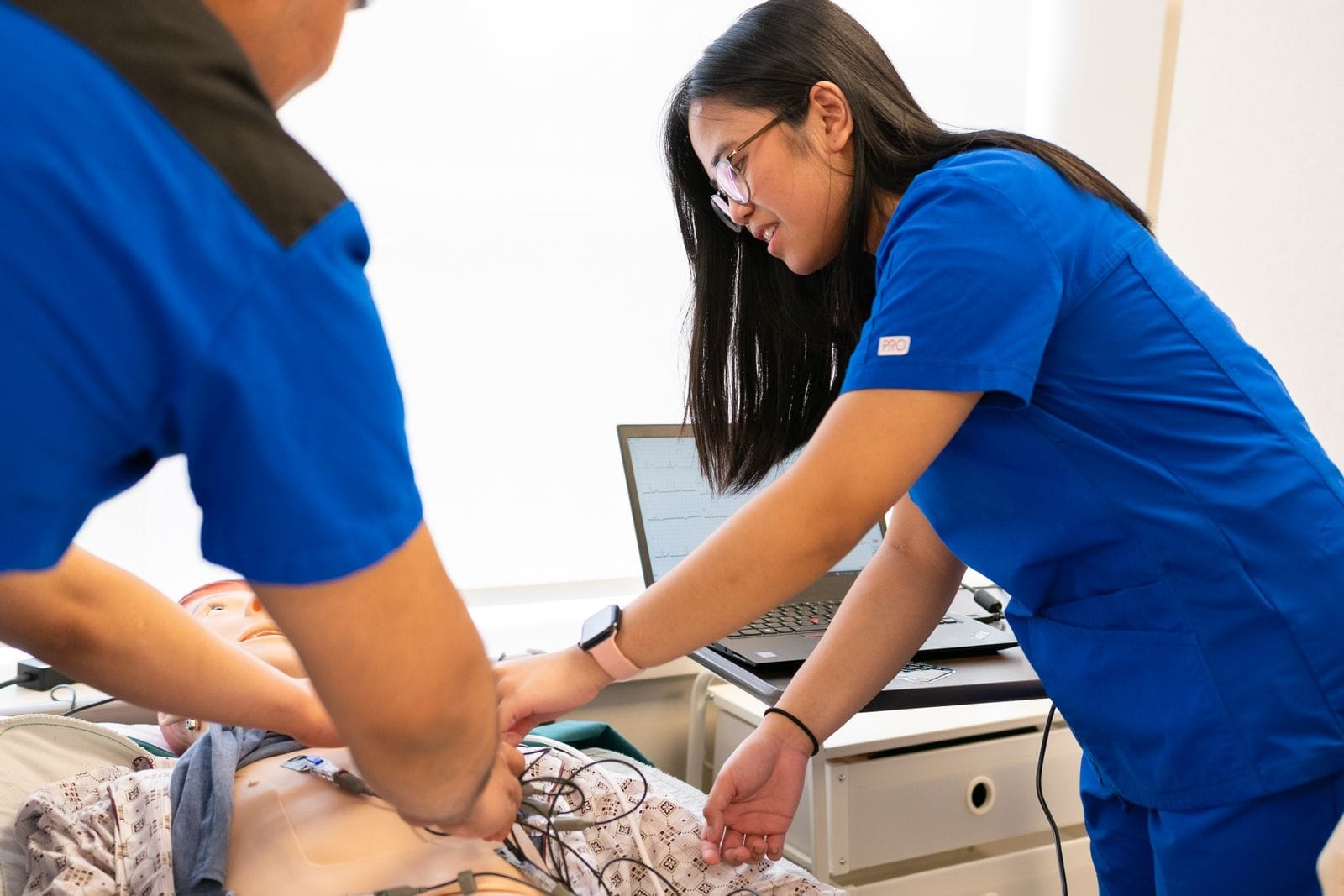
A year after demolition started, the third floor of the Health Sciences Center is a working simulation hospital, open for the spring 2026 semester. It has eight simulated patient rooms — an emergency bay, an ICU room, an operating room, a labor and delivery room, three medical-surgical rooms and a home-care apartment — plus a nurses’ station laid out like the program’s partner hospitals, a control suite behind one-way glass and three debriefing rooms.
Sofia Rasmussen runs the scenarios. She explains the rhythm the faculty built everything around: about 15 minutes in the room, then a 45-minute structured debrief in which students watch video of themselves. “The scenario is the excuse. The debrief is the class.” She also introduces Harold, the high-fidelity manikin who can be programmed to deteriorate, respond to medication and, on request, complain about the food.
Dean Laura Vance covers the money and the reasons: the $6.8 million conversion was paid for by $3.9 million in state capital funds, an $800,000 federal health-workforce award and $2.1 million in private gifts, including $148,300 raised for equipment on the 2025 Ironclad Giving Day. She talks about the “rural night” scenario the program has run since 2019, in which one nurse handles a cardiac event with a 40-minute ambulance response and a telehealth physician on a lagging video link, and why the new home-care apartment makes it more realistic. Athletic training, dietetics and regional hospitals’ continuing-education days share the floor.
Chapters
| Time | Chapter |
|---|---|
| 00:00 | Cold open: a monitor alarm and a paused room |
| 01:15 | A floor of offices becomes a hospital |
| 06:40 | Fifteen minutes in, forty-five minutes out |
| 13:20 | Meet Harold |
| 18:55 | Behind the one-way glass |
| 24:30 | Paying for it: state, federal and 3,206 Giving Day donors |
| 30:10 | Rural night, and why the lag is realistic |
| 36:45 | Who else uses the floor |
| 41:00 | Credits |
Selected transcript
An excerpt, lightly edited for reading. The full speaker-labeled transcript is in your podcast app’s transcript view, or email podcast@uwporterfalls.edu for an accessible document.
Abe Tollefsrud: Sofia, I watched a scenario this morning from the control room. You paused it in the middle. Why?
Sofia Rasmussen: Because she had just picked up the wrong syringe, and in about four seconds she was going to notice. I wanted to ask her what she was thinking before she noticed. Afterward everybody remembers being right. I want the moment before.
Corinne Lacasse: That sounds stressful for the student.
Sofia Rasmussen: It is, a little. That’s fine. The alternative is that her first real code happens on a real patient at two in the morning in Lake City. Here, the patient is Harold. Harold doesn’t mind. Harold has been coded, by my count, a little over nine hundred times.
Laura Vance: And he never files a complaint, which I appreciate as a dean.
Corinne Lacasse: Dean Vance, the old setup used the first-floor skills lab and a van to Lake City twice a week. What changes?
Laura Vance: Volume, mostly, and teams. We can run four scenarios at once now, and we can put a nursing student, an athletic training student and a dietetics student in the same room with the same patient, which is what their jobs will actually look like. Nobody in a hospital works alone. We were teaching as if they did because we only had one room.
Abe Tollefsrud: And rural night?
Laura Vance: Rural night is my favorite thing we do. One nurse, a crashing patient, an ambulance forty minutes out and a doctor on a video call that freezes. Students ask whether the freezing is a budget problem. It is not. It is a fidelity feature.
Links mentioned
Fictional information
UW–Porter Falls is a work of parody. This simulation hospital, its budget and funders, the faculty quoted and a manikin named Harold are invented; nothing here is clinical training or medical advice, and no episode exists to play.