
The question
The Porter County Rural Health Network runs four primary-care clinics — Tamarack, Little Cedar, Grange Hollow and Otter Bend — between 17 and 31 miles from Porter Falls. The nearest hospital is in Lake City, about 48 minutes from Tamarack when the roads are good. Clinic nurses see the same pattern every winter: an older patient with heart failure gains a few pounds of fluid over a week, does not want to make the drive, and arrives by ambulance.
Dr. Grace Vasquez, professor of nursing, whose work focuses on gerontological and public health nursing, wanted to know whether nurse-led check-ins at home could catch that week early. The project, called Home Connect, grew out of the long partnership described in “Twenty-Three Nurses and a County”.
The approach
Home Connect enrolled 64 patients aged 65 and older with heart failure or chronic lung disease, all patients of the four clinics, after review by the Institutional Review Board. Each household received:
- a cellular-connected scale and blood-pressure cuff that send readings to the clinic each morning;
- a tablet set up for one-tap video calls, with large print instructions taped to the back;
- a weekly 15-minute video visit with a clinic nurse, joined by a supervised Porter senior nursing student;
- a same-day call when weight rose more than three pounds in two days or blood pressure crossed an agreed threshold.
Outcomes are compared against a matched group of clinic patients from the two years before the program: emergency visits, hospital admissions, readmissions within 30 days, and how many enrolled patients are still using the equipment after six months. The work sits in the Center for Rural Health & Aging.
Students on the team
Ten senior nursing students rotate through Home Connect as part of their community-health clinical in NURS 4200 Community and Population Health; three more students are paid research assistants:
- Kaitlyn Moua, senior, nursing — coordinates the student video-visit schedule with the four clinics.
- Ben Hartwig, junior, health information management — manages the de-identified dataset and the alert log.
- Sela Tuilagi, sophomore, nursing — equipment setup and home visits, always with a clinic nurse.
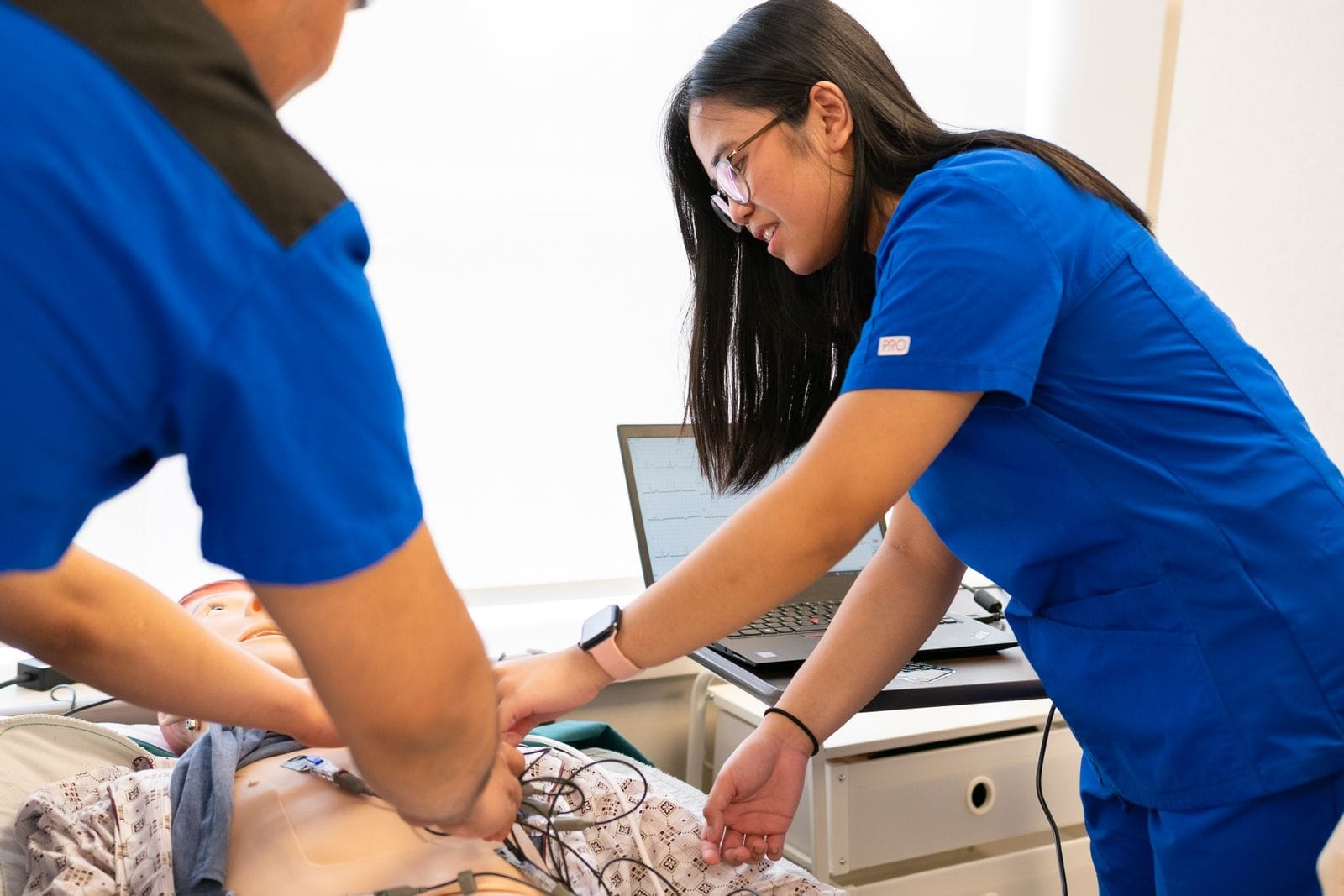
Students practiced the video visits first in the Health Sciences Center simulation hospital, including the version where the connection freezes in the middle of a medication question. On real calls a clinic nurse is always the clinician of record; students take the history, review the week’s readings with the patient and document under supervision. Several patients now ask for “their” student by name, which creates its own scheduling problem every time a semester ends. The team handles it with a handoff call in the last week of each term, in which the outgoing and incoming students join the same visit.
What they found so far
Twelve months in, with small numbers and the usual caution about early results:
- 23 percent of enrolled households had no usable home internet for video. A cellular hotspot fixed most of them; four households near Otter Bend still have no reliable signal and use a phone-only version.
- Among enrolled patients, the 30-day readmission rate was 11 percent, compared with 19 percent in the matched comparison group. With 64 patients, the team calls that encouraging, not proven.
- Weight alerts flagged 37 episodes of fluid gain; 29 were managed with a medication change by phone and a next-day clinic visit.
- Six-month retention was 81 percent. The most common reason for quitting was not technology but a spouse’s illness or a move to assisted living.
“We planned a study about heart failure and spent the first two months on cell towers. That is rural health care. The infrastructure is the intervention.”
— Dr. Grace Vasquez, professor of nursing
What’s next and who’s involved
Year two adds 40 patients and a second arm in which a trained community health worker, rather than a nurse, makes the weekly call, which would make the model cheaper to sustain. The team will also test whether the clinic telehealth carts can host video visits for patients without any home connection.
Partners: the Porter County Rural Health Network (four clinics and their nurses) and Porter County Health, under its ten-year rural health workforce partnership with the university. Funding is a three-year, $412,000 grant from the Lake City Regional Health Foundation. Students interested in rural practice should also look at the Rural Health Scholarship.
Fictional information
UW–Porter Falls is a work of parody. Home Connect, the Porter County Rural Health Network and its clinics, the Lake City Regional Health Foundation, the patients, students and every outcome figure here are invented; this is not medical advice, and anyone needing care should contact a real provider. The faculty profile linked here is fictional too; no real person, company, agency or community is described, and none of these findings should be relied on for anything.