
Program overview
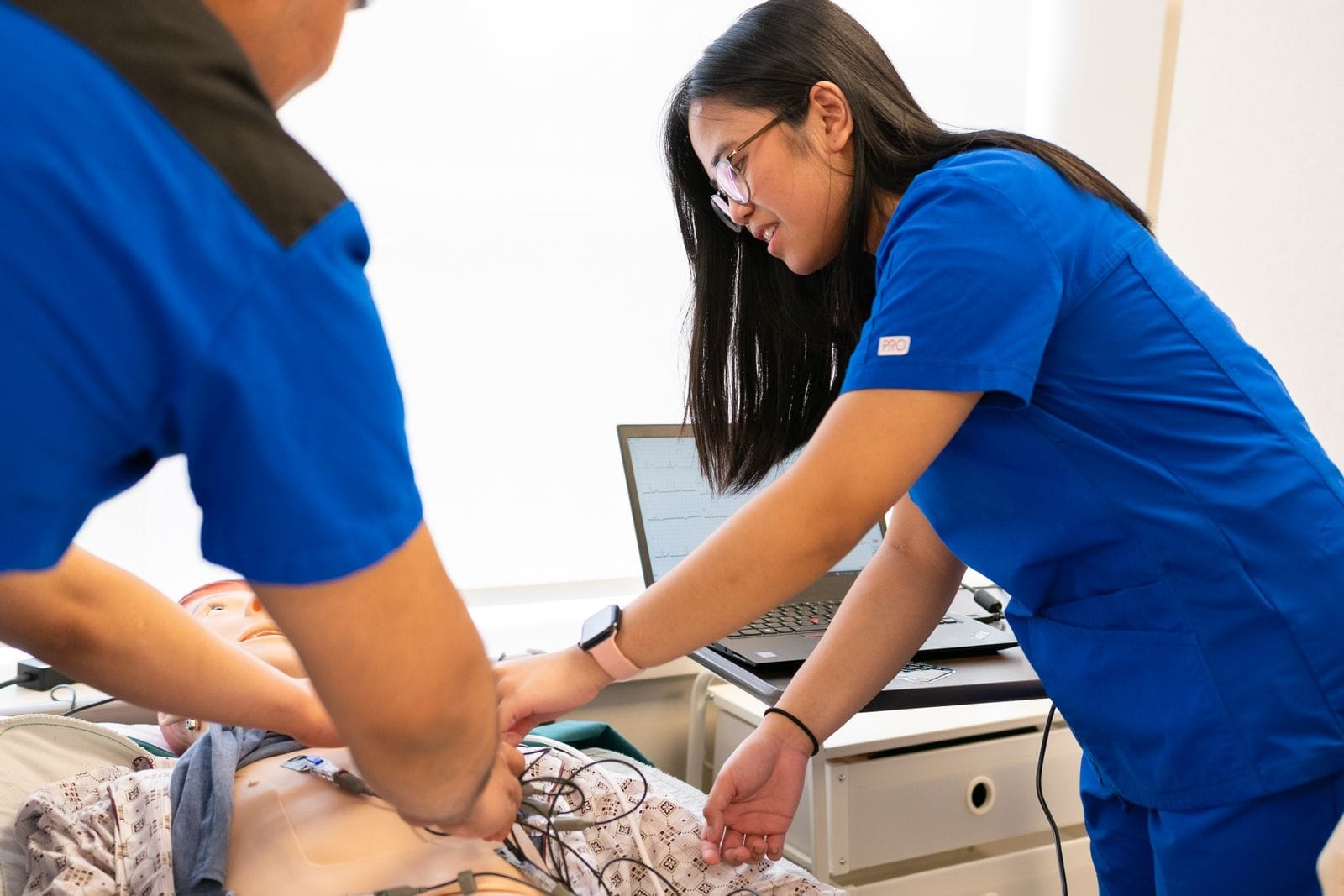
The Bachelor of Science in Nursing (B.S.N.) (124 credits, CCNE-accredited) sits in the College of Health Sciences and admits ~80 students per cohort (fall start only). Direct admission from high school is the primary pathway — no separate nursing application after freshman year. The program is built around clinical judgment development: simulation, clinical, and classroom are integrated weekly, not siloed by semester. Facilities: Nursing Simulation Center (Health Sciences Building 2nd floor, 12,000 sq. ft.): 8 high-fidelity rooms (Laerdal SimMan 3G+, SimMom, SimBaby, SimJunior), 6 standardized-patient suites, 4 debriefing rooms with video capture, Pyxis med-dispensing trainers, EHR training environment (Epic Playground). Faculty: 22 full-time (18 PhD/DNP, 4 MSN), 12 clinical adjuncts (Valley Health staff), 1:8 clinical faculty-to-student ratio.
Curriculum and simulation
Semester 1 (fall freshman): NURS 1100 Foundations of Nursing Practice (skills lab + sim: vital signs, asepsis, medication math), NURS 1200 Health Assessment (standardized patients), BIOL 2100 A&P I, CHEM 1100 General Chemistry. Semester 2: NURS 1300 Fundamentals Clinical (Valley Health med-surg, 1 day/week), NURS 1400 Pharmacology I, BIOL 2200 A&P II, PSYC 1100 Lifespan Development. Sophomore year: Med-surg I&II, mental health, OB/peds (sim + clinical), pathophysiology, pharmacology II, research methods. Junior year: Complex care (ICU/ED sim), community health, leadership, informatics, electives (wilderness nursing, forensic, global health). Senior year: Capstone preceptorship (320 hrs, 1:1 with RN preceptor at Valley Health or Lake City Medical Center), transition-to-practice seminar, NCLEX intensive. Simulation thread: Every clinical course has a paired sim scenario (pre-brief, run, debrief) — 400+ sim hours by graduation.
Clinical rotations at Valley Health
Valley Health Porter Falls Clinic and Valley Health Hospital (Lake City, 40 min via regional coach) are the primary clinical partners. Rotation sites: Med-surg (3 units, 28 beds each), ICU (12 beds), ED (24 bays, Level III trauma), OB (LDRP, 12 rooms), Peds (10 beds + NICU Level II), OR (8 suites), Behavioral Health (16 beds), Community Health (county health dept., school-based clinics). Scheduling: 8-hr shifts (6:30 a.m.–3 p.m. or 2:30–11 p.m.), 1–2 days/week depending on semester. Transportation: University runs a Clinical Shuttle (departs Founders Hall 5:45 a.m. / 1:45 p.m., returns 4:15 p.m. / 11:45 p.m.) free with student ID. Preceptors: Valley Health RNs complete a 4-hr preceptor workshop (co-facilitated by nursing faculty); 1:1 or 1:2 preceptor:student ratio. Simulation-to-clinical bridge: Before each new clinical rotation, students complete a Sim Orientation (4 hrs) covering unit-specific equipment, protocols, and emergency scenarios.
Admission pathways
Direct Admission (Freshman): 3.7+ GPA (unweighted), 4 years science (biology, chemistry, physics preferred), 4 years math, TEAS composite 75%+ (or SAT 1200+ / ACT 25+). Holistic review: Essay (why nursing, 500 words), 2 references (1 science teacher), healthcare experience (volunteer, CNA, EMT — not required but valued). Transfer (Sophomore entry, 10 seats/year): A&P I&II, Microbiology, Chemistry, Statistics, English — all B+, 3.5+ college GPA, TEAS 80%+. LPN-to-BSN Bridge: Active LPN license, 1 year experience, 3.0+ GPA in prereqs — advanced placement (skip fundamentals), 3-year completion. Second Degree (ABSN, 15 months): Bachelor’s in any field, 3.2+ GPA, prereqs complete — intensive Jan–May start. Scholarships: Caring Hands Scholarship (full tuition, 4 years, 6/year), Rural Health Scholarship (tuition + stipend, 2-year service commitment in Wesconsin Critical Access Hospital). Full admission details.
NCLEX preparation and pass rates
Integrated prep: ATI Comprehensive Predictor (semesters 4, 6, 8), Kaplan Q-bank (unlimited access, funded by program), weekly NCLEX-style quizzes in every clinical course, senior-year NCLEX Intensive (3 weeks, 30 hrs/week: content review, CAT practice, test-taking strategies, wellness). Pass rates (first-time, NCLEX-RN): 2023: 94%, 2024: 94%, 2025: 94% (national avg ~89%). Remediation: Students scoring <90% on Predictor get a personalized study plan + weekly check-ins with NCLEX Coach (faculty role, 0.25 FTE). Results: 100% of 2025 cohort passed by second attempt (max 45 days post-graduation).
Career outcomes
Class of 2025 (78 graduates): 96% employed as RN within 3 months (median $68K base + shift differentials), 2% in RN-to-BSN/MSN programs, 2% military (Army Nurse Corps, Air Force). Top employers: Valley Health (34 hires, med-surg, ICU, ED, OB), Lake City Medical Center (18), Wesconsin Hospital Association rural network (12), Mayo Clinic Health System (6), VA Health Care (4). Specialty distribution: Med-surg 35%, ICU/ED 25%, OB 15%, Peds 10%, Psych 8%, OR/Peri-op 7%. Retention: 92% still in nursing at 2 years (national ~85%). The Career Services Health Sciences Career Fair (February) brings 30+ healthcare employers; Valley Health offers conditional employment letters to seniors in October.
Fictional information
UW–Porter Falls is a work of parody. The program, facilities, clinical partners, statistics, and outcomes described here are invented for this fictional university. No real nursing programs or healthcare institutions are depicted.