
What these spotlights are
Research at UW–Porter Falls is mostly applied: a cheesemaker with a packaging problem, a village water utility that cannot afford a security audit, a machine shop that throws away cutting tools with a third of their life left. The projects below are a cross-section of that work as it stands in October 2026. Each one is led by a faculty member you can look up, funded by a named (and fictional) sponsor, and staffed largely by undergraduates who are paid for their time.
These are not press releases about finished work. Several projects are halfway through, and the “what they found so far” sections say so. The Office of Research & Sponsored Programs updates the page each fall and spring; older spotlights move to the center pages once a project closes out.
FY2026 research at a glance
Fiscal 2026 (July 2025–June 2026) was a record year: faculty brought in $9.1 million across 78 awards, up from $7.4 million the year before, from 141 proposals submitted (the May announcement). About sixty undergraduates were paid research assistants on funded projects, up from about forty.
| Sponsor type | Awards | Amount |
|---|---|---|
| Federal (including the multi-year Porter River monitoring award) | 24 | $5.2M |
| State (led by a manufacturing-innovation grant) | 11 | $2.3M |
| Industry and regional employers | 29 | $0.9M |
| Foundations and nonprofits | 10 | $0.5M |
| Local government and other | 4 | $0.2M |
| Total | 78 | $9.1M |
The industry line looks small next to the federal one, but it is the most numerous: 29 awards averaging about $31,000, most of them one- or two-semester contracts with a company inside a 60-mile radius. Three of the eight spotlights below are that kind of project.
The 2026–27 spotlights
- Will this bale mold? Screening recycled plastic before it reaches the press
- Dr. Colin Nguyen’s students test what is really inside the polypropylene bales a regional recycling cooperative sells, and built a three-test screen that catches most bad lots.
- Keeping farmstead cheese sealed: packaging shelf-life for small creameries
- Dr. Grace Nakamura and a guild of nine Porter County cheesemakers trace leaking vacuum packs to wrinkles, not film.
- Home Connect: nurse-led telehealth for older adults in rural Porter County
- Dr. Grace Vasquez’s team runs weekly video check-ins and home monitoring for 64 patients of four rural clinics, and found the internet was the first problem to solve.
- A water tower in the basement: a cyber range for small water utilities
- Dr. Nadia Molnar built a working miniature water system in Jarvis Technology Center so village operators can practice spotting tampering.
- Counting mussels in the cold reach of the Millrace
- Dr. Grace Beaumont’s field crew pairs mussel surveys with Riverwatch temperature data to test whether groundwater seeps are why mussels survive in one stretch.
- Listening to the end mill: predicting CNC tool wear with a regional machine shop
- Dr. Everett Fontaine’s team uses spindle-load and vibration data to change cutting tools when they are worn, not when a counter says so.
- Porter Reads: early-literacy tutoring in small rural classrooms
- Dr. Kendra Reinholt’s education majors tutor 186 kindergarten through second-grade readers in six rural schools, three mornings a week.
- Cold walls: testing insulation retrofits for Wesconsin winters
- Dr. Gustav Okafor’s test hut at the University Farm measures what happens inside a wall after you insulate it.
How students get onto a project
Every project on this page employs undergraduates, and most hired at least one first- or second-year student who had no research experience. The usual routes:
- Paid research assistant. Positions are posted on the campus job board and by the department, typically 8–12 hours a week at the standard student research rate.
- Course credit. An independent-study registration tied to one project and one supervisor, or a capstone team assigned to a partner’s problem.
- Your own grant. Student research grants and the Porter Research Scholars Program fund students who want to add their own question to an existing project.
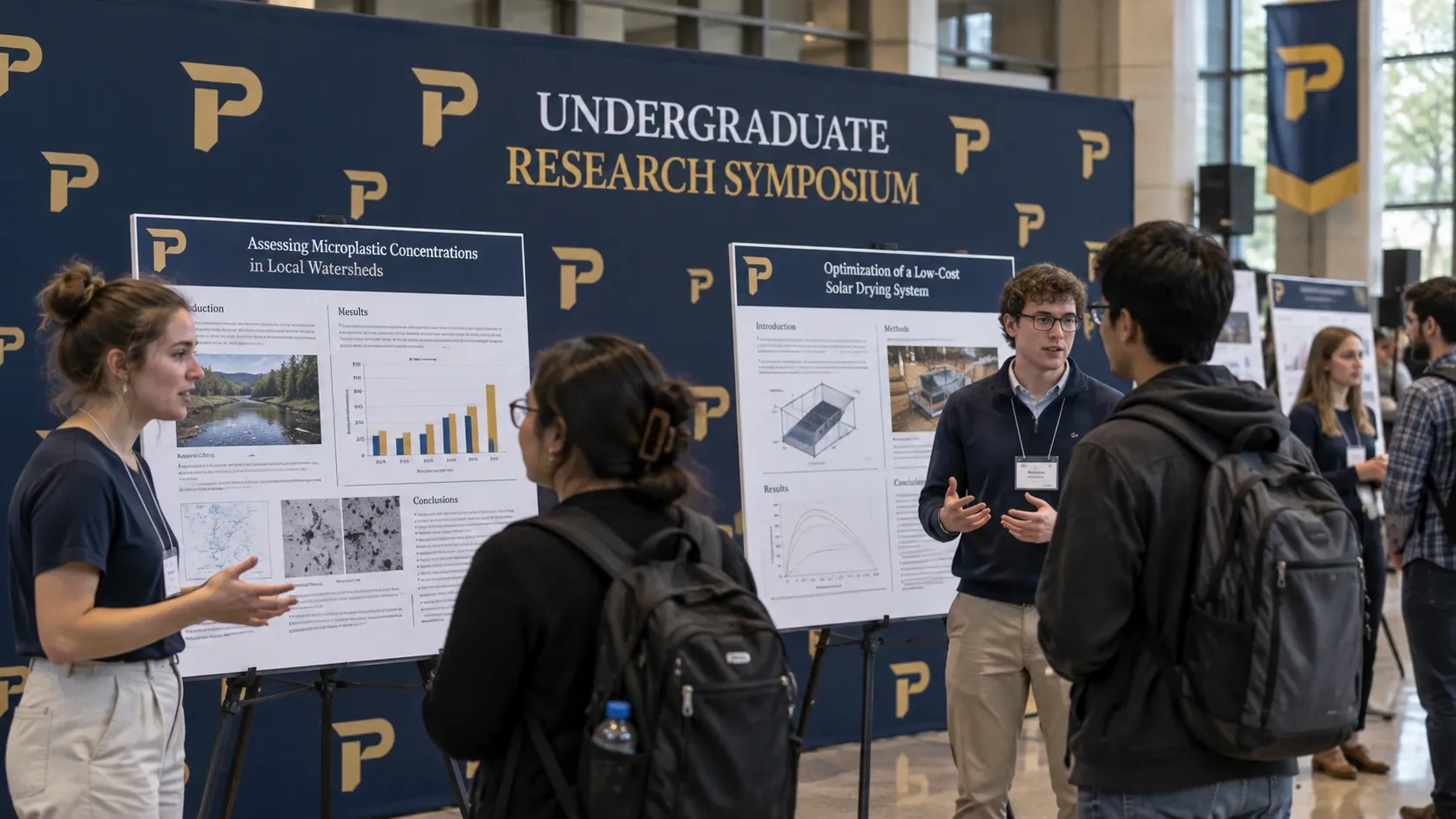
The practical advice on undergraduate research applies: email the faculty lead about the specific project, say why it interests you, and ask for a conversation. Results from most of these projects will be presented at the spring undergraduate research symposium.
Bringing a question to Porter
Every partner on this page started the same way: a phone call or email to the Discovery Center, which scopes the problem, matches it to a faculty member, center, course or capstone team, and handles the agreement. Industry projects under $50,000 can use the university’s two-page sponsored-project agreement. See For employers & partners for the full menu, or sponsoring a capstone project if the question fits a two-semester student team.
Fictional information
UW–Porter Falls is a work of parody. These research projects, the faculty and students on them, their sponsors and partners, and every funding total and finding on this page are invented; no real research is reported here.