
A ditch with a past
The Millrace was dug by hand in 1856: an 1,800-foot channel that peeled off the Porter River above the falls to turn the wheels of a sawmill and, later, an ironworks. It is why the town is where it is, and in a roundabout way it is why the university’s teams were called the Millwrights for seventy years until a 1994 student vote made them the Ironclads.
The mill dam came out in 1920. It left behind a four-foot vertical drop at the Millrace outlet that no fish could climb. By the 1970s, alumni from that era remember the channel mainly as “the ditch,” a place where shopping carts went to retire.
“We used to dare each other to jump it. You could, at the narrow spot behind what’s now Millrace Hall. You would not want to land in it.”
— Gary Solheim ’74
The capstone that got built
In fall 2022 a five-student Civil Engineering capstone team led by Abby Sorensen ’23 took on a problem the city, the county and the state natural resources agency had been circling for a decade: how to get fish past the four-foot drop without rebuilding the outlet.
Their answer was a 120-foot roughened channel beside the drop — a series of engineered riffles at a 3 percent slope, with 1.5-foot steps and resting pools between them. They modeled it for two semesters, built a 1:10 scale version in the hydraulics lab, and presented it to a joint city-county committee in April 2023.
“Everybody’s capstone gets presented. Almost nobody’s gets poured. When they called to say it was funded, I was in a grocery store, and I sat down on the floor in the cereal aisle.”
— Abby Sorensen ’23
The Forge Prototyping Lab fabricated the steel forms and monitoring brackets; the state agency’s crews did the heavy earthwork. The $380,000 cost was split 60 percent state grant, 25 percent university and 15 percent the Porter River Riverkeepers, a volunteer group that raised its share mostly through a pancake breakfast and, by its own account, “a raffle that got out of hand.” The Millrace Fish Passage opened in October 2024.
Forty-seven trout
Students in the university’s Riverwatch program maintain 12 water-quality stations along the river and the Millrace. Before the passage opened, they had begun tagging brook trout downstream with passive integrated transponder tags — tiny chips read by antennas as fish swim past.
In the first spawning season, spring 2025, antennas at Station 3, below the passage, and Station 7, above it, recorded 47 tagged brook trout making the climb. That summer, student crews found the first evidence of natural trout reproduction in the Millrace corridor in more than 60 years.
“We had one tag read at Station 7 and then, forty minutes later, at a spot that made no hydrological sense. We eventually worked out it was inside a great blue heron. So the official count is forty-seven trout, and also one heron that is doing very well.”
— Sofia Ekberg-Moe, environmental science senior and Riverwatch station lead
Monitoring of the second season was under way as this issue went to press. More on the network, the stations and the data is on the Porter River & Millrace Ecology page.
Planting the banks
Trout need cold water, and cold water needs shade. Between 2023 and 2025, the Riparian Corridor Project planted 3,200 native trees and shrubs along 1.5 miles of the main stem from campus to Depot Plaza: silver maple, river birch, red osier dogwood, buttonbush, ninebark and elderberry. Environmental Science capstone teams designed the plantings; volunteers logged more than 1,200 hours putting them in.
- Shade cover on the planted stretch is up about 35 percent.
- Bank erosion, measured at fixed photo points, is down about 60 percent.
- The annual garlic mustard pull on Earth Day draws more than 200 volunteers, many of them alumni who return each year with the same gloves.
“Planting a tree is the easy part. Keeping 3,200 of them alive through two droughts and a hungry deer population is a logistics job. My students now know more about tree guards than anyone should.”
— Dr. Henrik Moe, associate professor of environmental science
The trail beside it
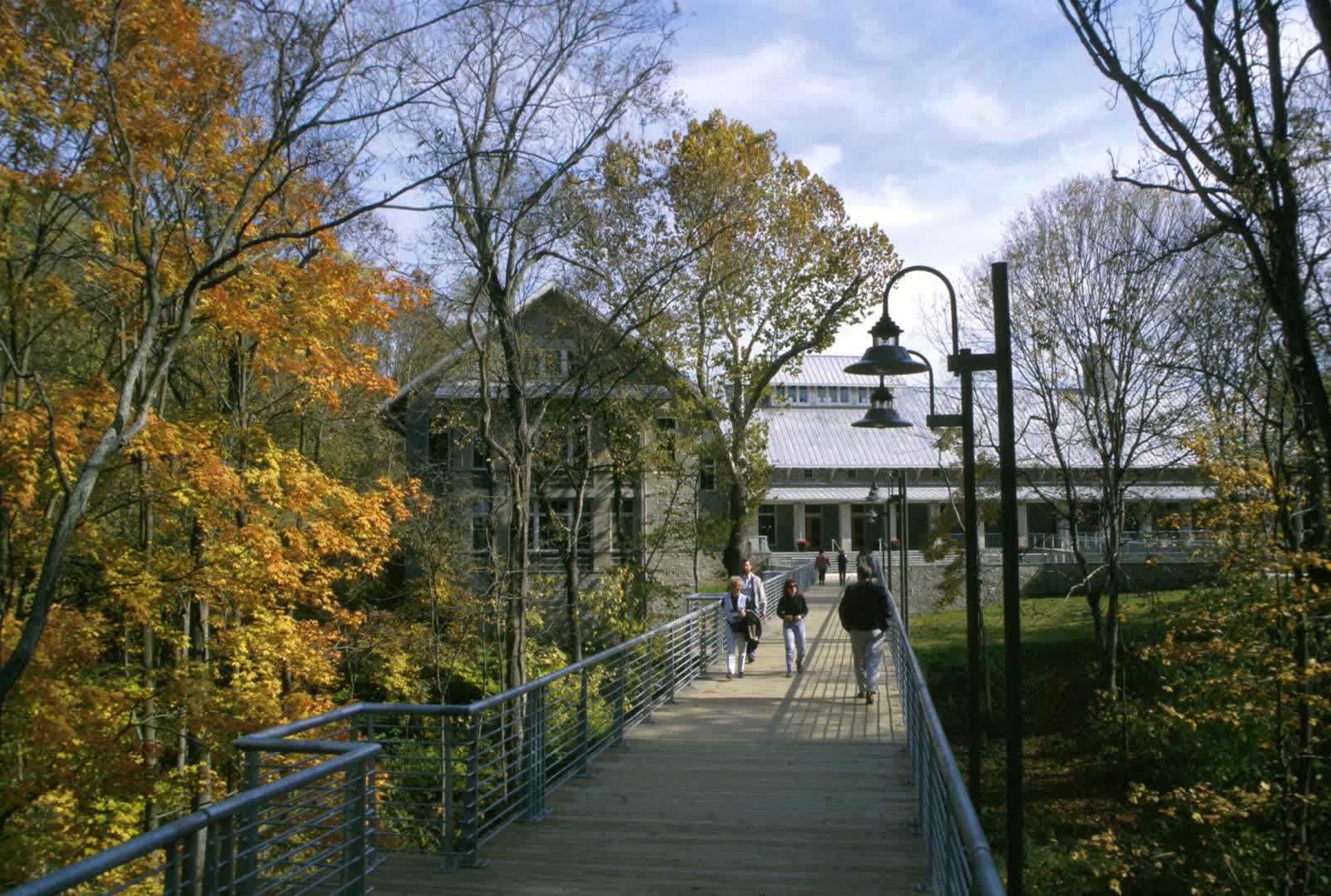
Most people meet the Millrace from the Riverfront Trail, the town’s 3.2-mile paved path along both banks of the Porter River. Its middle segment, the 1.2-mile Millrace Loop, crosses the channel on the historic pedestrian bridge and carries interpretive signs on the town’s industrial history — written, in 2019, by students in a public history course and fact-checked by University Archives. The trail logs more than 1,200 trips a day, peaking between 5 and 7 p.m. on weekdays.
The city resurfaced the Millrace Loop last summer under the direction of city engineer Brian Sandvik ’03, who confirmed the bridge’s load rating is well above what the Millrace Week alumni 5K puts on it. The 5K route runs the Campus Reach and the Millrace Loop, which means several hundred alumni a year now jog past a fish passage designed by students who were not born when they graduated.
Practical advice on using the riverfront, including where not to wade, is on The Millrace and Porter River.
What comes next
The next project is upstream. A Civil Engineering course in stream restoration design is working on the Cedar Creek tributary, which has its own, smaller barrier and its own, smaller trout. Students are also tracking road-salt runoff from five tributaries to inform the city’s winter salting plan, and mapping cold groundwater seeps with a drone-mounted thermal camera built in the Prototyping Lab.
“When I came here people told me the Millrace was a ditch. Now it’s a stream with fish in it, and I can show you the data. I’d like the next class to inherit a river.”
— Sofia Ekberg-Moe
She is not, she wishes to make clear, related to Dr. Moe. The department has stopped finding this funny. Nobody else has.
Fictional information
UW–Porter Falls is a work of parody. The Millrace, its fish passage, the trout counts, the heron and the students and faculty quoted are invented, and the Porter River does not exist; please do not go looking for it with waders. Porter Falls Magazine does not exist, no issue is printed or mailed, and every person, quotation, number and anecdote in this story is invented.