
Six-forty, every morning
Lyle Haugen unlocks the Founders Hall high bay at 6:40 a.m. He is one of nine people outside Facilities who has a key, a privilege he describes as “mostly a responsibility to be early.” He turns on the lights in three banks, checks the pendant on the 1948 overhead crane, fills a coffee mug that says “Millwrights Wrestling 1987” (he has never wrestled), and walks the floor once, end to end, looking for anything a student left running, leaning or leaking.
By 7:45 the first section of MACH 1100, Machining Fundamentals, is standing at the engine lathes in safety glasses. Haugen has taught some version of that course every semester since August 1988 — 76 fall and spring terms, by his count, plus a few summers he would rather not discuss. He estimates about 4,100 students have made their first cut in his shop. He remembers, he says, “a worrying number of their parts.”
The floor
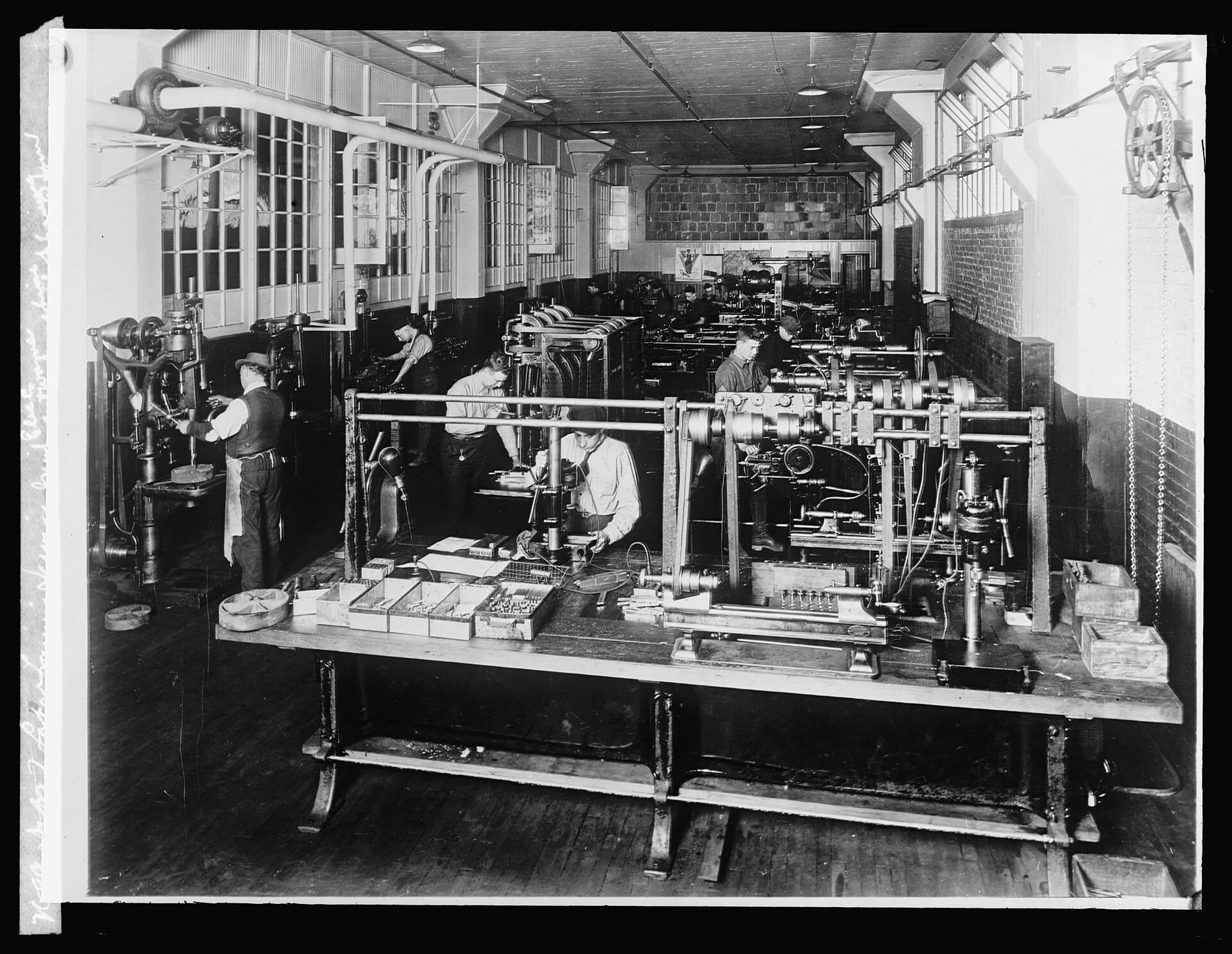
The high bay’s floor is the original 1912 machine-shop floor, end-grain wood block set in pitch, which has outlasted three renovations of the building around it and is still in daily use. Haugen can read it. The dark rectangles near the north wall are where a line of belt-driven lathes stood until 1951. There is a shallow dip in front of lathe 6 worn by a century of students shifting their weight while they waited for a cut to finish.
“People ask why we don’t pour concrete,” he said. “Drop a tool on concrete and you lose the tool. Drop it on wood block and you lose your dignity, which grows back.”
The shop today holds 14 engine lathes, 12 knee mills, four surface grinders, a horizontal bandsaw that he calls “the only machine in here that has never surprised me,” and, through a glass wall installed in 1997, nine CNC machining centers used by the CNC Machining certificate and Manufacturing Engineering. Haugen is not, despite his reputation, against computers.
“A CNC machine does exactly what you tell it. That is the problem. On a manual lathe you feel the cut go wrong in your hands before it goes wrong in the part. I want every student to have felt that once, so they know what the program is doing when they can’t feel anything.”
— Lyle Haugen ’81, senior lecturer, Machine Tool Technology
Three instructors since 1912
Haugen grew up in Cedar Bluff, the son of a feed-mill mechanic, and came to Porter in 1977 to become a shop teacher. He graduated in 1981 in Industrial Technology Education, then spent seven years at a Cedar Bluff tool-and-die shop, running a jig borer on second shift. In the spring of 1988 his own former instructor called to say he was retiring and that Haugen should apply.
That instructor was Arne Kjos, who ran the machine shop from 1952 to 1988. Kjos had been hired by Emil Sandvik, who ran it from 1912, the year Founders Hall opened, until 1952. Which means that in 114 years the high bay has had three lead instructors, each trained by the one before.
“Arne used to say Emil taught him to sweep before he taught him to cut. Arne taught me the same. I teach it the same. The broom is older than the lathes.”
— Lyle Haugen
Arne Kjos died in March at 97. Haugen was a pallbearer. He is remembered in In Memoriam, along with a note from his granddaughter, a 2008 nursing graduate.
The hammer, and other sayings
Every MACH 1100 student makes the same first project: a small steel ball-peen hammer, turned, milled, knurled and heat-treated, with the head held to plus-or-minus two thousandths of an inch. Graduates text Haugen photos of their hammers from job sites, ship engine rooms and, once, a hospital maternity ward. A shelf above his desk holds 31 hammers that were never picked up. He will not say whose they are, “but some of you know.”
Students keep an unofficial list of what they call Haugenisms. A few, verified with the source:
- “Measure twice, cut once, deburr always.”
- “The machine is not mad at you. The machine does not know you exist.”
- “If you’re leaning on it, it’s a fixture, and we didn’t design it.”
- “Chips go in the bin. Not in your pocket, not in your hair, not in your shoes.”
- “Close enough is a number. Tell me the number.”
Jordan Vue ’21, now a project engineer on the Founders Hall renovation, keeps his hammer on his desk in the construction trailer. “I failed my first knurl,” he said. “Lyle looked at it and said, ‘That’s a texture, not a knurl.’ I think about that sentence every time someone hands me a drawing.”
The pour
Haugen is also the person in the heat-resistant apron at the Thursday-night Foundry pour during Millrace Week, which he started in 1991 as a demonstration for about 40 people and which now draws more than 1,100 into the high bay and out onto the Founders Hall lawn. He has run 35 of them; the 2020 pour was canceled, and he still describes it as “the year we didn’t.” He also supervises the pewter pour for First Forge during orientation, where he has personally handed a ladle to more than 30 classes of new students.
“First Forge is the only day of the year anyone is excited to be in a safety briefing. I try not to waste it.”
— Lyle Haugen
This year’s pour is Thursday of Millrace Week, 7 p.m. Closed-toe shoes required, as the signs on the door have said since 1991.
What happens next
The $15 million Founders Hall renovation starts next summer and runs one wing at a time over three summers. The high bay is in the last phase. Its floor stays. Its wiring, Haugen notes, does not, “which is the right call for both of us.”
In 2025 the department hired Kayla Fjelstad ’14, a manufacturing engineering graduate who spent nine years running a production machine shop in Lake City. She co-teaches two sections of MACH 1100 and runs the open shop hours. Haugen insists she is not his successor; she is “the next one,” which, in a shop with three instructors in 114 years, may be the same thing.
Asked when he plans to retire, Haugen said he would go “when the floor does.” The renovation plans preserve the floor. He did not seem troubled by the implication.
Fictional information
UW–Porter Falls is a work of parody. Lyle Haugen, Arne Kjos, Emil Sandvik, the hammer shelf and the high bay’s 114-year line of instructors are invented, and the machine counts and Foundry pour figures are fictional. Porter Falls Magazine does not exist, no issue is printed or mailed, and every person, quotation, number and anecdote in this story is invented.