
Eleven days in 1926
Nils Ruud’s ledger for the summer of 1926 is a narrow, cloth-bound book with a cracked spine, now kept in University Archives. On June 7 he recorded the delivery of “timber, 14 loads” from a sawmill on the Porter River. On June 18: “Raised. 61 men. 9 hams.” On June 28: “Roof on. Paid the boys.” Total cost of the barn, by his arithmetic, $3,412.60, of which $41 was the hams.
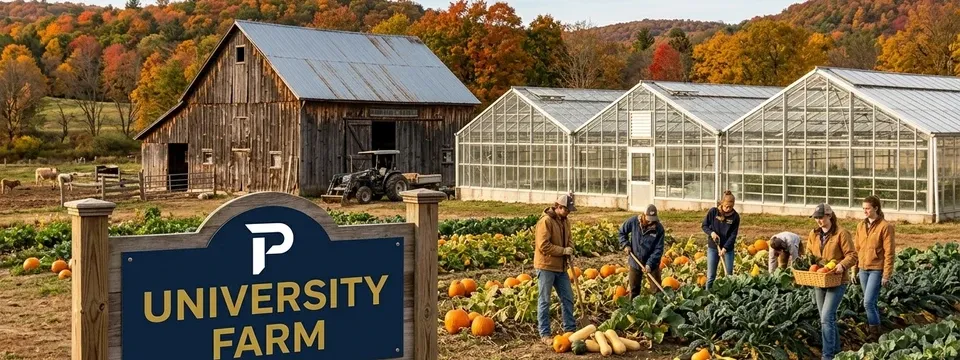
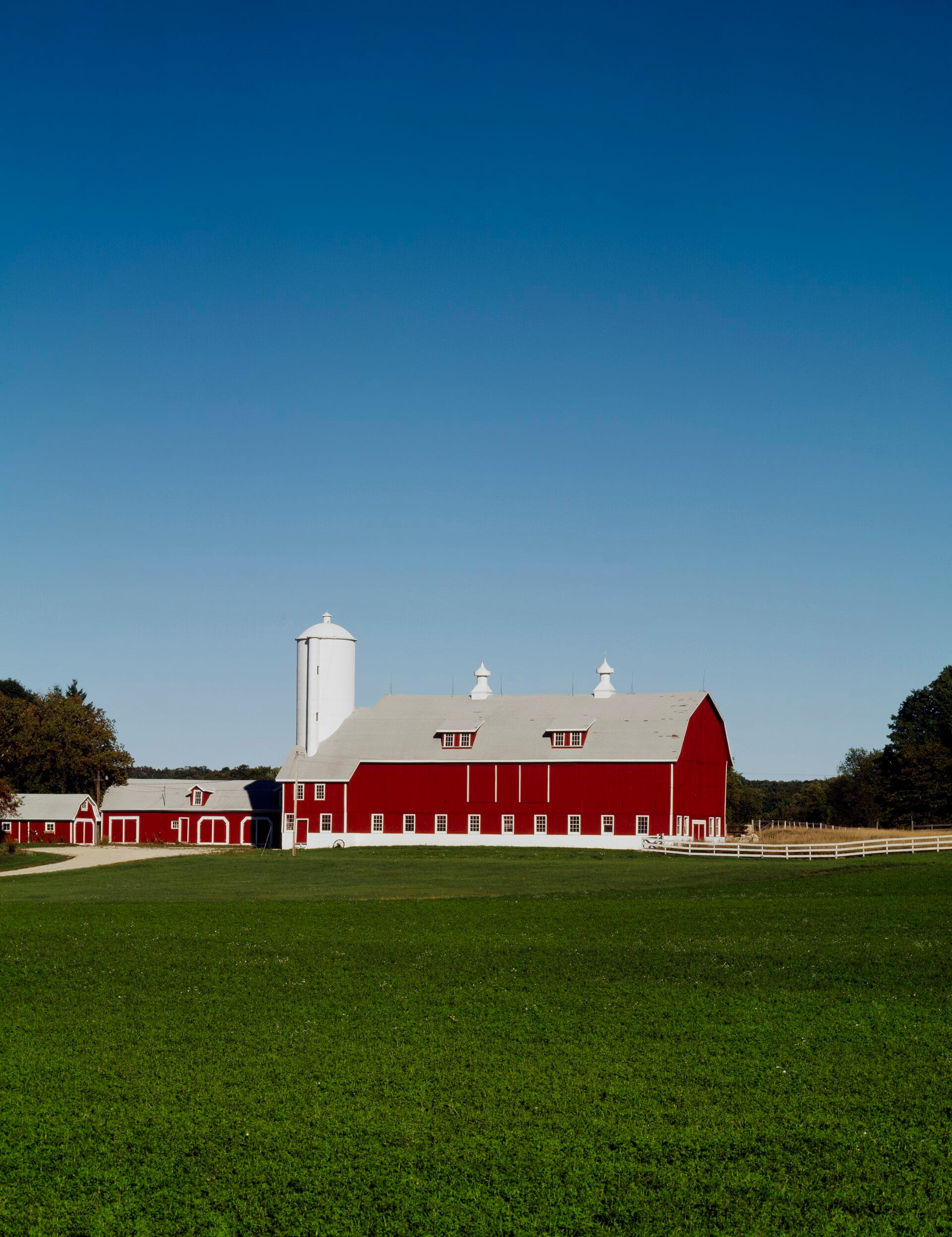
The barn he built is 40 by 96 feet, with a gambrel roof and a hayloft that once held 9,000 bales. It is the oldest structure on the University Farm, about 40 acres east of the main campus.
The deed
The Ruud family had farmed the land since 1871. By the 1950s the last of the third generation, siblings Agnes and Theodore Ruud, were in their seventies and had no children who wanted the farm. In 1958 they deeded it to the university with one condition: the land had to stay in agricultural teaching use.
That clause has been tested exactly once. In 1974, a campus master plan proposed paving the farm’s west six acres for commuter parking. A law student who was also a Ruud grandnephew read the deed at a public hearing. The parking lot went elsewhere.
“Aunt Agnes used to say, ‘They can have it as long as they keep growing something on it.’ She meant crops. I think she’d accept students.”
— Kevin Ruud ’89, Food Science, who now volunteers at the farm
What the barn does now
The ground floor was converted to a classroom in 1998 and renovated again in 2016. It seats 48, has a projector that Facilities describes as “barn-rated,” and smells, faintly and permanently, of hay. The old milking parlor is a wash-and-pack room for produce. The hayloft holds research equipment, seed stock and, from September through October, a borrowed cider press.
A typical fall week in the barn:
| Day | Who | What |
|---|---|---|
| Monday | Environmental Science | Soil-health lab; cores from the cover-crop plots |
| Tuesday | Dietetics | Farm-to-tray menu planning, overflow from the teaching kitchen |
| Wednesday | Campus garden club | Washing and packing produce for the food pantry and the campus farmers market |
| Thursday | Industrial Design | Studio critique for a farm-equipment ergonomics project |
| Friday | Summer research assistants | Stormwater sampling, then a long argument about the data |
| Saturday | The public | Fall open house: orchard, wagon tours, the pumpkin patch |
The farm also anchors the Agricultural & Food Systems Institute, whose high tunnels and greenhouses sit just south of the barn, and the teaching kitchen programs.
The pumpkin economy
The barn’s best-known product is not research. It is pumpkins. The patch south of the barn went in in 2009 as a soil-science demonstration plot comparing three cover-crop rotations, and someone noticed that the plot produced, as a byproduct, about 1,500 pumpkins nobody had a plan for. They were sold off a wagon at the fall open house for $2 each. They were gone by noon.
The patch now covers two and a half acres and produces about 4,000 pumpkins a year, still sold at the open house, now for $3, with the proceeds going to the student food pantry in Founders Union. Last year that came to $11,240. Students in the soil-health lab still collect data from the plot, and still publish it, but they acknowledge that the experiment has, in the words of one senior’s lab report, “been somewhat overtaken by its outreach component.”
“Every October a family drives in from Lake City and asks which pumpkins are the research ones. I tell them all of them. That’s true. It also helps sales.”
— Nora Bakke, University Farm manager since 2012
The cider press in the hayloft came later, in 2017, on loan from a Cedar Bluff orchard that went out of business and never asked for it back. It presses about 300 gallons each fall from the farm’s small orchard, most of it consumed on site by people who had planned to buy only a pumpkin.
Keeping a 100-year-old barn standing
Old barns die from the bottom and the top. Between 2019 and 2021, the university replaced both. A standing-seam steel roof went on in 2019, replacing cedar shakes from the 1960s. In 2021, a capstone team from Construction Management designed and supervised the replacement of 64 feet of rotted sill beam on the south wall, jacking the barn up three-quarters of an inch at a time over four weekends.
“We had a professor, a structural engineer, a timber framer from Cedar Bluff and eleven students, and every one of them had an opinion about the jacks. The barn did not move a sixteenth more than we planned. I’m prouder of that than of my diploma.”
— Jordan Vue ’21, capstone team lead
Duane Kolsrud, director of Facilities, keeps the barn keys on a green-capped section of his famous ring. “It’s the only building on campus,” he said, “where the lock is older than the projector by about seventy years and works better.” The barn swallows, which have nested in the loft every summer of record, are left alone by policy and by mutual agreement.
The centennial
The farm will mark the barn’s hundredth year at its fall open house on Saturday, September 26, 2026, from 10 a.m. to 3 p.m. Planned so far:
- Wagon tours every half hour from the visitor lot, with a stop at the 1958 deed’s boundary stone.
- Nils Ruud’s 1926 ledger, on display in the barn classroom, on loan from Archives for one day.
- Cider pressed from the farm’s own orchard, and about 4,000 pumpkins at $3 each, proceeds to the student food pantry.
- A group photo of every Ruud descendant who can make it. Kevin Ruud says there are at least 40.
- No hams. The farm considered it.
The Porter Loop shuttle runs its weekday farm stop on the Saturday of the open house. The visitor path, barn classroom and teaching kitchen are step-free; field areas are not. Details are on the University Farm page.
Fictional information
UW–Porter Falls is a work of parody. The Ruud family, the 1926 barn, its ledger, the 1958 deed and the centennial open house are invented; there is no farm to visit and no pumpkins to buy. Porter Falls Magazine does not exist, no issue is printed or mailed, and every person, quotation, number and anecdote in this story is invented.